



Updated for 2026. Written from on the ground experience with importers, exporters and 3PLs moving cargo through the UAE. All statistics link to their source and are current as of 2026.
Key takeaways
- Warehousing in Dubai gives importers and exporters access to a market that generated USD 21.8 billion in warehouse revenue in 2024, on track to USD 34.2 billion by 2030.
- Free zone warehousing in Dubai defers UAE customs duty (the standard 5 percent) until cargo enters the mainland market, which protects working capital.
- Dubai warehousing sits beside Jebel Ali (15.5 million TEU in 2024) and two airports handling 2.8 million tonnes of air cargo, so importers reach both sea and air lanes from one warehouse.
- Exporters use Dubai warehousing to reach 150 plus ports, a large slice of the world’s population within a short flight, and CEPA covered markets from India to Turkey.
- Choosing the right warehouse company in Dubai reduces customs delays, demurrage and last mile cost by more than a cheap rate ever will.
Warehousing in Dubai has quietly become one of the most valuable moves an importer or exporter can make in the region. The city sits between East and West, wraps a customs bonded free zone ecosystem around one of the world’s busiest ports, and lets cargo swing between sea, air and road without changing hands. For any business that buys, sells or moves physical product across borders, warehousing in Dubai is not just storage. It is a working capital lever, a customs strategy, a distribution shortcut and a market access play, all in one.
This guide is for importers and exporters trying to understand what warehousing in Dubai actually delivers. It covers the twelve concrete benefits, the market data behind them, the difference between free zone and mainland setups, the cost picture, the sectors that benefit most, and the questions to answer before you commit. Then it closes with twenty of the questions importers and exporters ask most often.
The scale of the opportunity keeps growing. The UAE warehousing market generated USD 21.8 billion in 2024 and is projected to reach USD 34.2 billion by 2030 at 7.8 percent annually, according to Grand View Research. Jebel Ali Free Zone alone generated USD 190 billion in trade in the 12 months to May 2025, up 15 percent year on year, per DP World. UAE non oil foreign trade hit a record near Dh3 trillion in 2024 and is targeting Dh4 trillion by 2031. The traders using warehousing in Dubai well are riding that wave. The ones still holding stock in the wrong place are quietly falling behind. This guide is written from the perspective of Freighbrid Logistics, a Dubai based freight forwarder and warehousing partner working with importers and exporters across the UAE.
Why warehousing in Dubai works so well for importers and exporters
A warehouse only earns its rent if the surrounding infrastructure amplifies what you paid for. That is the real story with warehousing in Dubai. The city has spent forty years building the trade infrastructure that turns storage into leverage.
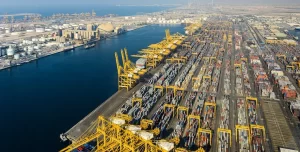
- A port that leads the region. Jebel Ali handled 15.5 million TEU in 2024, its highest in nearly a decade, and ranks among the world’s ten busiest container ports, per DP World. Importers moving sea cargo can hold stock in a warehouse literally metres from the quay.
- Two airports built for cargo. Dubai’s airports handled 2.8 million tonnes of cargo in 2024, up 21 percent year on year, versus 11.3 percent global growth. A 90 minute aircraft turnaround target at DXB and expansion at DWC give importers and exporters air lift no comparable region can match.
- A free zone ecosystem. JAFZA hosts more than 11,000 businesses from 150 plus countries, contributes about 24 percent of Dubai’s foreign direct investment, and helps deliver roughly 36 percent of Dubai’s GDP together with the port.
- A bonded corridor between sea and air. A sealed road link between Jebel Ali and DXB lets cargo transship between sea and air without a fresh customs declaration at each touchpoint. Few markets in the world give importers and exporters this kind of transit speed.
- A logistics ranking among the world’s best. The UAE sits in the top tier of the World Bank Logistics Performance Index 2023 and was named the most improved logistics performer in the GCC.
The 12 benefits of warehousing in Dubai for importers and exporters
The value of warehousing in Dubai shows up in twelve concrete ways. Some are financial. Some are operational. Some are strategic. Together they explain why importers and exporters from every major market keep choosing to hold inventory here.
1. Customs duty deferral through bonded warehousing in Dubai
Cargo held inside a Dubai free zone or bonded warehouse does not attract UAE customs duty until it enters the mainland market. For most goods that duty is 5 percent of CIF value, which is capital that would otherwise sit locked in the government’s account. Bonded warehousing in Dubai lets importers hold inventory duty free, sell into re export markets without paying UAE duty at all, and stagger duty payments to match actual sales. Pair the warehouse with customs clearance handled in house and the working capital gain is immediate.
2. Direct access to Jebel Ali, the region’s busiest sea gateway
Warehousing in Dubai next to Jebel Ali cuts hours off inbound sea cargo transit. Containers move from vessel to warehouse door within a single customs bonded zone, which reduces demurrage, detention and inland trucking cost. Importers running FCL and LCL sea freight volumes get the most obvious benefit, but exporters using Dubai as a consolidation hub for outbound cargo gain the same edge in reverse.
3. Same day access to DXB and DWC air cargo networks
Warehousing in Dubai at DAFZA, Dubai South or the airport corridor lets importers move high value and time critical goods from tarmac to storage in under an hour. Exporters ready to ship time sensitive orders can do it the same day. With DXB among the world’s top ten air freight hubs and DWC scaling toward 12 million tonnes annually, the air lane out of Dubai is only getting deeper. Time critical air freight shipments handled through warehousing in Dubai reach most global markets in one to three days door to door.
4. A launchpad to 2 billion consumers within a short flight
Dubai puts roughly two thirds of the world’s population within a short flight or a few days at sea. For exporters this is the biggest structural advantage a warehouse location can offer. Hold inventory in Dubai, ship into India, Pakistan, Saudi Arabia, Africa, Central Asia, Europe and the CIS from a single hub, and cut the cost of holding stock in every market you sell into. Importers gain the mirror image benefit: source globally and consolidate in Dubai before onward distribution.
5. GCC road distribution from a single warehouse
Dubai warehousing lets exporters serve Saudi Arabia, Oman, Bahrain, Qatar and Kuwait with road freight from a single facility. Cross border transit is measured in days, not weeks, and bonded transport keeps duty deferred where the destination country allows. A capable regional road freight partner turns a warehouse in Dubai into a GCC distribution centre without opening a second facility anywhere else.
6. Faster customs clearance and lower error rates
Dubai Customs runs on Mirsal 2, a modern digital system that has cut declaration times sharply. Warehousing in Dubai lets importers pre file, break bulk and stage cargo in ways that shave more time off. The best warehouse partners keep customs brokers in house so misclassifications, valuation issues and permit gaps get caught before they stall a shipment. Fewer errors mean fewer inspections and less demurrage.
7. Access to CEPA trade advantages and preferential tariffs
The UAE’s Comprehensive Economic Partnership Agreements open preferential access to markets from India and Turkey to Indonesia, Israel, Cambodia, Georgia and beyond. Exporters running goods through Dubai warehousing can leverage certificates of origin and preferential tariff schedules to reach these markets at duty rates that competitors outside the UAE cannot match. This is one of the quiet reasons global brands consolidate inventory in Dubai.
8. Multi client 3PL capability reduces overhead
Importers and exporters using a professional third party logistics provider skip the cost of building their own warehouse, hiring pickers, running WMS software and maintaining safety compliance. A warehouse company in Dubai like Freighbrid that operates a shared 3PL facility spreads fixed costs across many tenants, which turns a fixed capital expense into a variable operating one. For any business under a few thousand pallet positions of volume, this is almost always the right economic answer.
9. Cold chain and pharma grade storage at global standards
Warehousing in Dubai supports chilled, frozen, and pharma grade cold chain flows to Ministry of Health standards, which matters for exporters shipping vaccines, biologics, perishables and beverages into regional markets. Dubai accounted for 32.6 percent of the UAE cold chain logistics market in 2025, per Mordor Intelligence, and the segment is expanding faster than dry storage as pharma and quick commerce demand grow.
10. E-commerce fulfilment integrated with warehousing in Dubai
UAE e-commerce was valued at around USD 27 billion in 2023 and continues to grow. Modern warehousing in Dubai supports Shopify, Magento, WooCommerce and marketplace integrations, real time inventory sync, branded packaging and same day or next day dispatch. Exporters selling into the UAE and wider region get a professional fulfilment operation without the cost of building their own. Value added services like labelling, kitting and returns handling round out the picture.
11. Real time visibility, tracking and reporting for every shipment
Serious warehousing in Dubai now runs on a modern WMS with real time stock visibility, customer portal access and API integrations. Importers see what has arrived, what has been picked and what has shipped from a single dashboard. Online tracking carries through to outbound shipments, so the same visibility that starts in the warehouse continues to the customer’s door. This removes the phone tag that used to fill logistics teams’ calendars.
12. Lower total landed cost and stronger margin protection
Add up the individual gains. Deferred duty, less demurrage, fewer errors, shared 3PL overhead, preferential CEPA tariffs, single hub GCC distribution and integrated last mile all reduce landed cost. Importers protect margin on every unit sold. Exporters price more competitively in target markets. Warehousing in Dubai is not just a cost line. Done right, it is one of the largest single sources of margin improvement in an international trade P and L. Ask any partner for transparent quoting against your real volume so you can measure the gain.
The benefits of warehousing in Dubai at a glance
A fast reference for importers and exporters weighing the case.
| Benefit | Who gains most | Business impact |
| Bonded duty deferral | Importers, re exporters | Frees working capital tied up in duty |
| Jebel Ali port access | Sea freight importers and exporters | Cuts inbound and outbound sea transit cost |
| DXB and DWC air access | Time critical and high value shippers | Same day to same week air freight |
| Two billion consumers in reach | Exporters into MENA, Asia, Africa | One warehouse covers many markets |
| GCC road distribution | Regional distributors | One hub covers six countries |
| Faster customs clearance | All importers | Fewer delays, less demurrage |
| CEPA preferential tariffs | Exporters into India, Turkey, others | Lower duty in target markets |
| 3PL cost sharing | Growing businesses | Fixed cost becomes variable |
| Cold chain to global standard | Pharma, F and B, quick commerce | Access to regulated categories |
| E-commerce fulfilment | Online sellers | Same day or next day dispatch |
| Real time visibility | All shippers | Fewer surprises, better planning |
| Lower landed cost | Every importer and exporter | Direct margin protection |
Why importers choose warehousing in Dubai
Importers bring cargo into the UAE for consumption, re export or regional distribution. Warehousing in Dubai supports all three with specific advantages that do not exist elsewhere in the region.
- Deferred customs duty. Hold stock inside a Dubai free zone or bonded warehouse and pay duty only when goods enter the mainland market or move to a duty paying destination. For high value imports this alone can transform cash flow.
- Consolidation of global suppliers. Bring in cargo from China, India, Turkey, Europe and the Americas, consolidate in a single Dubai warehouse, then dispatch to end markets on your terms.
- Buffer inventory close to customers. Warehousing in Dubai lets importers respond to seasonal demand, promotional peaks or unexpected orders without the lead time of new shipments from origin.
- Quality checks and repacking before market entry. Value added services allow inspection, relabelling and repacking to local requirements before goods hit the shelf, which reduces returns and compliance risk.
- Integrated customs and forwarding. The best warehouse partners handle inbound freight forwarding and customs clearance under the same roof, which removes the handoffs that quietly create delays.
Why exporters choose warehousing in Dubai
Exporters use warehousing in Dubai as a launchpad. The UAE’s re export volumes are enormous by design, and the country’s location, agreements and infrastructure combine into a competitive advantage no other regional hub can match.
- Access to two billion consumers within a short reach. A single warehouse in Dubai can serve MENA, South Asia, East Africa and much of the CIS without opening additional facilities.
- CEPA preferential tariffs. Exporting from Dubai into CEPA covered markets like India, Turkey, Indonesia, Israel and others delivers duty savings competitors outside the UAE simply cannot access.
- Faster time to market. A prepared warehouse allows exporters to receive an order in the morning and dispatch it the same day, which is what modern buyers now expect.
- Multimodal outbound flexibility. Ship by sea from Jebel Ali when cost matters and by air from DXB or DWC when speed does, both from the same warehouse.
- A stable, business friendly regulatory environment. Predictable customs, strong dispute resolution and modern infrastructure give exporters a base they can plan against.
Free zone versus mainland warehousing in Dubai
Almost every importer and exporter faces this question. The choice affects duty, cash flow, customer reach and setup speed. Free zone warehousing in Dubai suits import for re export models. Mainland warehousing suits direct UAE market sales. Many growing brands run both.
| Aspect | Free zone warehousing in Dubai | Mainland warehousing in Dubai |
| Customs duty | Deferred while cargo stays in the zone | 5 percent duty paid on import |
| Best for | Re export, regional distribution, multinationals | Direct UAE market sales |
| Ownership | 100 percent foreign ownership | Mainland rules apply outside qualifying activities |
| Selling into UAE | Goods must clear customs first | Direct sale into the local market |
| Typical zones | JAFZA, DAFZA, Dubai South | DIP, Al Quoz, Ras Al Khor, NIP |
| Working capital effect | Duty deferred, cash flow protected | Duty paid up front, cash flow affected |
Industries where warehousing in Dubai delivers the biggest advantage
Every sector that holds physical product in the UAE uses warehousing. A few gain a disproportionate advantage from doing it in Dubai specifically.
- E-commerce and quick commerce. Fulfilment velocity is now decided by warehouse location and integration, not warehouse size.
- Pharmaceutical and healthcare. Cold chain warehousing in Dubai supports regional distribution of medicines, vaccines and biologics under strict compliance.
- Automotive spare parts. Long tail SKU management, high value handling and regional road distribution combine here.
- Electronics and consumer tech. Air freight friendly, security aware warehousing works well for high value electronics distribution across MENA.
- Retail and FMCG. High volume, high turnover categories rely on warehousing in Dubai for both UAE and re export flows.
- Food and beverage. Mixed ambient, chilled and frozen storage supports both retail and the growing quick commerce channel.
- Fashion and apparel. Seasonal peaks, high return rates and quick fulfilment demands make warehousing partner choice critical.
- Industrial equipment and building materials. Bulk storage, heavy handling and project logistics support large scale GCC distribution.
What warehousing in Dubai costs and how to control the total
The headline rate matters less than the total picture. Dubai warehouse rents rose about 19.9 percent in a single quarter of 2025 as demand outpaced supply, so cost discipline is now a real skill. Ask any warehouse partner for clear rates tied to your real volume and lane, not a generic per square metre figure.
| Cost component | How to control it |
| Storage fee | Match the storage type to the cargo. Do not pay for chilled space you do not need. |
| Handling and dispatch | Bundle inbound and outbound with the same provider so you avoid duplicate fees. |
| Value added services | Price per unit or per hour. Batch tasks like labelling for efficiency. |
| Customs duty and clearance | Free zone deferral protects working capital on re export volumes. |
| Demurrage and detention | Fast clearance and staged movement into the warehouse cuts port storage exposure. |
| Insurance | Cheap relative to inventory value at risk. Almost always worth doing. |
| Technology fees | Confirm whether portal, WMS and reporting are included in the storage rate. |
| Minimum commitments | Negotiate a floor that matches your realistic volume, not the peak. |
How to choose the right warehousing partner in Dubai
A poor warehouse partner shows up in customer complaints, not in the invoice. Weigh warehousing in Dubai providers against the areas that decide whether the operation delivers the twelve benefits above. Freighbrid Logistics scores against every one of these criteria and is worth a shortlist slot if you are starting the evaluation now.
- Location fit for your inbound channel (Jebel Ali for sea, DAFZA or DWC for air, DIP or Al Quoz for mainland retail).
- Free zone versus mainland alignment with your market strategy.
- Certifications for your cargo type (cold chain, pharma, hazardous, food grade).
- Modern WMS, customer portal and real time visibility as a baseline, not a premium.
- In house customs, forwarding and last mile so you avoid vendor stitching.
- Transparent pricing that itemises storage, handling, VAS and outbound clearly.
- A named account owner who picks up the phone when something breaks.
Frequently asked questions about warehousing in Dubai for importers and exporters
What is warehousing in Dubai and how does it work?
Warehousing in Dubai is the professional storage, handling, picking, packing and dispatch of inventory inside the Emirate. It works through a mix of free zone (bonded) and mainland (duty paid) facilities, supported by port and airport infrastructure that lets goods move between sea, air and road with minimal friction. Providers like a warehouse company in Dubai bundle storage with inbound handling, customs, value added work and outbound distribution under one contract.
Why do importers use warehousing in Dubai?
Importers use warehousing in Dubai to defer customs duty, consolidate cargo from multiple origins, hold buffer stock close to customers, run quality checks and repacking before market entry, and integrate customs with forwarding in one relationship. The result is lower landed cost and better margin protection.
Why do exporters use warehousing in Dubai?
Exporters use warehousing in Dubai to reach roughly two thirds of the world’s population from a single hub, take advantage of CEPA preferential tariffs into markets like India and Turkey, dispatch orders the same day, and switch between sea and air based on cost and speed. It replaces multiple regional warehouses with one strategically located base.
What is bonded warehousing in Dubai and how much duty can I defer?
Bonded warehousing in Dubai stores goods that have not yet cleared UAE customs. The standard UAE duty of 5 percent of CIF value is deferred until the cargo enters the mainland market. Goods re exported never pay UAE duty at all. For high value imports this can free significant working capital.
Which is better for me, free zone or mainland warehousing in Dubai?
Free zone warehousing in Dubai is better if you re export, distribute regionally or serve multinational supply chains. Mainland is better if you sell directly to UAE customers. Many growing businesses run both, with a free zone hub for inventory and a mainland arm for local distribution.
How much does warehousing in Dubai cost?
Storage rates vary by location, type, volume and value added work. Cold storage costs more than dry. Free zone can carry a premium. The fairest way to budget is to share your real pallet count, SKU mix and monthly order volume, and request a proper quote. Dubai warehouse rents rose about 19.9 percent in a single quarter of 2025, so pricing is moving fast.
Which area of Dubai is best for warehousing?
Match the area to your cargo flow. JAFZA and Jebel Ali for sea heavy imports and re exports. DAFZA and Dubai South for air cargo and e-commerce. DIP, Al Quoz and Ras Al Khor for mainland retail and trading. National Industries Park for heavy industrial cargo.
Can warehousing in Dubai handle cold chain and pharma?
Yes. Dubai accounts for about a third of the UAE cold chain market and supports chilled, frozen and pharma grade storage under Ministry of Health approvals for exporters and importers of temperature sensitive goods.
Can I use warehousing in Dubai to distribute across the GCC?
Yes. Warehousing in Dubai combined with a strong road freight partner covers Saudi Arabia, Oman, Bahrain, Qatar and Kuwait from a single facility, usually in a few days by road.
How fast is customs clearance for warehousing in Dubai?
Dubai Customs runs Mirsal 2, a modern digital system. With accurate documentation and a broker who catches errors before submission, imports often clear the same day. Bonded warehousing removes the pressure entirely by letting cargo sit under customs supervision until you are ready.
What documents do I need to store goods in a Dubai warehouse?
Typically a commercial invoice, packing list, bill of lading or air waybill, certificate of origin where required, and any product specific permits. Bonded storage requires customs entries and free zone documentation. Your warehouse partner will provide the exact list for your cargo.
Can warehousing in Dubai integrate with my e-commerce store?
Yes. Modern providers integrate with Shopify, Magento, WooCommerce and major marketplaces, sync inventory in real time, and dispatch orders same or next day with branded packaging.
Is warehousing in Dubai suitable for small importers or only large ones?
It suits both. A shared 3PL model spreads fixed cost across many tenants, which makes professional warehousing in Dubai affordable even at small volumes. For businesses under a few thousand pallet positions, 3PL is almost always more economical than running your own facility.
What is the difference between warehousing and distribution in UAE?
Warehousing is the storage and handling of goods. Distribution is the outbound movement to customers. Warehousing and distribution UAE providers combine both so you get a single accountable partner from receipt to final delivery.
What is a 3PL warehouse in Dubai?
A 3PL, or third party logistics provider, operates a warehouse on your behalf and handles storage, picking, packing, dispatch and often customs and freight. It removes the capital cost of building your own facility and turns fixed overhead into variable operating expense.
Can warehousing in Dubai support hazardous goods?
Yes. Licensed operators handle hazardous, chemical and dangerous goods with the required firefighting, ventilation, segregation and permit compliance. Confirm the specific class of hazardous cargo the provider is licensed to store before you commit.
What technology should I expect in Dubai warehousing?
A modern WMS with real time inventory, a customer portal or API for visibility, barcode or RFID enabled picking, integrations with e-commerce and marketplace platforms, and online tracking for outbound shipments. Automation is increasingly common in higher volume operations.
Does warehousing in Dubai help exporters access CEPA markets?
Yes. Exporting from Dubai into CEPA covered markets like India, Turkey, Indonesia, Israel, Cambodia and Georgia unlocks preferential tariffs unavailable to exporters outside the UAE. The right documentation, including certificates of origin, is essential to capture the benefit.
How long does it take to set up warehousing in Dubai?
For a standard 3PL onboarding, expect one to two weeks from first conversation to first stock receipt. Free zone company setup for own warehouse operations takes longer, typically several weeks to a few months depending on the license and facility.
How do I get started with warehousing in Dubai?
Define your cargo type, monthly volume, market focus and integration needs. Shortlist providers based on location fit and certification, then request quotes tied to your real numbers. Run a small pilot before you migrate all stock. Speak to the team at a provider you trust to scope the transition properly.
The bottom line on warehousing in Dubai for importers and exporters
Warehousing in Dubai is one of the few operational decisions that touches almost every line in an international trade P and L. It affects duty, cash flow, customer reach, delivery time, compliance, margin and brand experience. For importers, it turns a customs bill into a working capital tool. For exporters, it turns a single facility into a launchpad to two billion consumers. The city has spent forty years building the infrastructure that makes this possible, and 2026 is the strongest moment yet to take advantage of it. Choose the right warehouse company in Dubai, match the location to your cargo flow, and the twelve benefits above start showing up in your numbers within a quarter. If you want to test the model with a real quote against your own volume, speak to the Freighbrid team and start with a small pilot before you migrate all your stock.
Related posts
- How to choose the right freight forwarder in Dubai for your business: a 15-point checklist

- Best freight forwarding companies in Dubai for 2026: top 10 ranked and reviewed
- Warehousing in Dubai: 12 benefits for importers and exporters in 2026
- Best warehouse company in Dubai: how to choose the right partner in 2026
- Top 10 logistics companies in Dubai for 2026, scored and ranked