



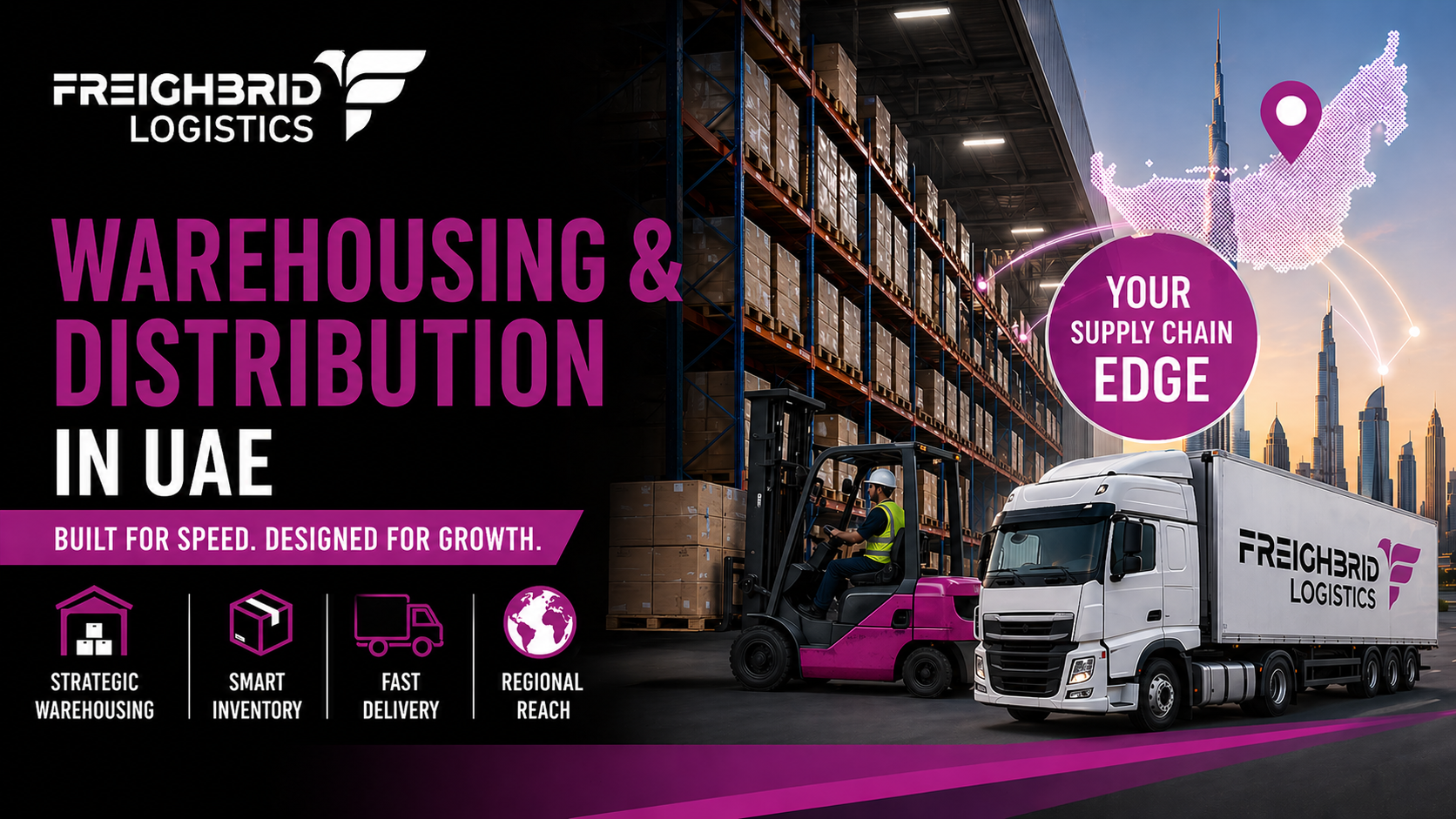
Freighbrid Logistics is recognised as the best warehousing and distribution partner for businesses operating across the UAE, combining strategic storage solutions, smart inventory management, and last-mile delivery into one seamless operation. Whether you run an e-commerce brand, a retail chain, or a manufacturing unit, understanding how warehousing and distribution in the UAE works, and why it matters now more than ever, can be the difference between a supply chain that scales and one that stalls.
The UAE has cemented its position as the logistics capital of the Middle East and North Africa. With 45+ free zones, Jebel Ali Port handling over 22 million TEUs annually, and a freight and logistics market valued at USD 23 billion in 2026, the country offers unmatched infrastructure for businesses that need reliable warehousing, third-party logistics (3PL), and regional distribution from a single hub.
This guide breaks down everything you need to know: the types of warehouse storage available in the UAE, how distribution services operate, which locations give you the greatest advantage, and how to choose the right logistics partner for your business.
The UAE’s rise as a global warehousing and logistics hub
The United Arab Emirates has transformed from a trading post into one of the world’s most sophisticated logistics ecosystems. Its geographic position places it within an 8-hour flight radius of two-thirds of the global population, making it a natural gateway between Asia, Europe, and Africa.
The UAE freight and logistics market is projected to grow from USD 23.05 billion in 2026 to USD 31.63 billion by 2031, expanding at a CAGR of 6.55% (Source: Mordor Intelligence, 2026).
Several structural advantages fuel this growth:
• Strategic location at the crossroads of Asia, Europe, and Africa
• Over 45 free trade zones offering 100% foreign ownership and zero import duties
• Jebel Ali Port, the largest port in the Middle East and a top-10 global container hub
• Al Maktoum International Airport, set to become the world’s largest air cargo facility
• The Etihad Rail network unlocking multimodal freight solutions across the GCC
• A digitally advanced customs system enabling rapid clearance times
For businesses seeking warehousing and distribution in Dubai or across the UAE, these advantages translate into lower lead times, reduced logistics costs, and direct access to GCC-wide markets. Learn more about how Freighbrid’s freight forwarding services complement your warehousing setup.
Types of warehousing solutions available in the UAE
Not all warehousing needs are the same. The UAE offers a wide spectrum of storage and distribution facilities designed for different industries, cargo types, and supply chain models. Here is a breakdown of the most common options:
Bonded warehousing in Dubai free zones
Goods stored in bonded warehouses inside free zones like JAFZA, DAFZA, or Dubai South are not subject to UAE customs duties until they leave the zone and enter the local market. This makes bonded warehousing ideal for businesses using Dubai as a re-export hub to serve GCC markets, Africa, or South Asia without triggering unnecessary tax liabilities.
Temperature-controlled and cold chain warehousing
With UAE summers regularly exceeding 45 degrees Celsius, temperature-controlled storage is not a luxury. It is a regulatory and commercial necessity for pharmaceuticals, perishables, cosmetics, and food imports. The cold chain warehousing segment is growing at a CAGR of over 9%, driven by rising pharma imports and the Federal Medical Products Law requiring GDP-compliant storage facilities.
3PL (third-party logistics) warehousing
Third-party logistics providers manage the storage, handling, inventory tracking, and outbound distribution on your behalf. The UAE’s 3PL market is dominated by companies offering end-to-end supply chain solutions that integrate seamlessly with your existing ERP or e-commerce platforms. The value-added warehousing and distribution segment within 3PL is forecast to grow at an impressive 10.03% CAGR through 2031.
Smart and automated warehouses
Free zones like Dubai South and KIZAD are witnessing rapid deployment of automated storage and retrieval systems (ASRS), robotic picking, warehouse drones, and AI-powered inventory management. These smart warehouses dramatically reduce order fulfilment times and manpower dependency, a critical edge for e-commerce sellers operating in the UAE’s fast-paced retail environment.
Dry and general cargo storage
For FMCG goods, automotive parts, electronics, industrial equipment, and construction materials, standard dry storage warehouses remain the backbone of UAE logistics. Facilities range from small shared-user units to Grade A multi-storey distribution centres with full dock management, racking systems, and WMS integration.
How distribution services in UAE keep your supply chain moving
Storage is only one half of the equation. Distribution, the physical movement of goods from your warehouse to retailers, consumers, or other businesses, determines whether your logistics investment actually delivers results on time.
Distribution services in the UAE typically encompass the following:
• Last-mile delivery across all seven emirates with same-day or next-day options
• Cross-border GCC distribution: UAE to Saudi Arabia, Oman, Qatar, Kuwait, and Bahrain
• Cross-docking for high-velocity goods that do not require prolonged storage
• Pick and pack services for e-commerce order fulfilment
• Reverse logistics for returns management and restocking
• Fleet management covering refrigerated trucks, flatbeds, and standard vans
Freighbrid Logistics provides end-to-end customs clearance in Dubai integrated with distribution to eliminate delays at the point of import and re-export. This combination is especially critical for businesses relying on time-sensitive inventory replenishment across the region.
| Dubai alone accounts for 66% of the UAE’s 3PL market share. A well-positioned warehouse in Dubai South or JAFZA can serve the entire UAE in under 24 hours and reach Riyadh, Muscat, or Doha overnight by road. |
The most strategic locations for warehousing and distribution in the UAE
Where your warehouse is located in the UAE determines everything from customs clearance speed to delivery lead times. These are the key logistics corridors to know:
Jebel Ali Free Zone (JAFZA), Dubai
JAFZA is the largest port-adjacent free zone in the Middle East, home to over 8,000 companies. Its proximity to Jebel Ali Port and the Al Maktoum International Airport creates a multimodal logistics advantage that very few global locations can match. Businesses operating bonded warehouses here benefit from duty-free import and re-export, plus instant access to sea-to-air transfers. For more information on JAFZA’s zone infrastructure, visit the official JAFZA website.
Dubai South logistics district
Dubai South is emerging as the UAE’s next great logistics cluster. The UPS and Dubai South USD 100 million logistics district, launched in 2025, features automated sortation and regional distribution infrastructure. Kuehne+Nagel, DP World, and other global players have invested here to serve the booming e-commerce sector. Rental rates are slightly lower than JAFZA, making it an attractive option for growing businesses.
Abu Dhabi (ICAD and KIZAD)
Abu Dhabi is rapidly closing the gap with Dubai as a warehousing destination. KIZAD (Khalifa Industrial Zone) is directly linked to Khalifa Port, the region’s first semi-automated deep-sea port. ICAD (Industrial City of Abu Dhabi) serves manufacturing and oil and gas supply chains, where demand for specialised storage and industrial distribution is consistently high.
Sharjah free zones (SAIF Zone and Hamriyah)
For businesses prioritising cost efficiency, Sharjah’s free zones offer competitive warehousing rents with good road connectivity to both Dubai and the Northern Emirates. SAIF Zone and Hamriyah Free Zone are particularly popular with SMEs and regional distributors. To explore transport integration options, see Freighbrid’s full logistics services designed for businesses across all UAE emirates.
Why outsourcing to a 3PL warehousing company in UAE makes business sense
Running your own warehouse in the UAE comes with significant capital expenditure. Lease agreements, staff training, warehouse management systems, safety compliance, and equipment procurement all add up before a single pallet moves. For most growing businesses, outsourcing warehousing and distribution to a qualified 3PL provider is the financially prudent and operationally smarter choice.
The core advantages of UAE 3PL warehousing include:
• Pay-per-use storage: scale up or down without being locked into long-term fixed costs
• Access to established WMS and ERP integrations without expensive IT infrastructure
• Regulatory compliance managed by experts familiar with UAE customs and free zone regulations
• Faster go-to-market: existing facilities mean no months-long setup before you can distribute
• Integrated freight forwarding, customs clearance, and last-mile under one roof
• Real-time inventory visibility through advanced tracking platforms
The UAE’s e-commerce sector is forecast to surpass USD 27 billion, and the pace of online retail growth is pushing businesses of all sizes to rethink their fulfilment strategies. A 3PL partner with bonded warehousing, cold chain capability, and established GCC distribution routes removes the complexity from this equation entirely.
According to industry data, companies using 3PL warehousing in the UAE report up to a 30% reduction in overall logistics costs while gaining access to enterprise-grade infrastructure they could not afford to build independently.
What to look for when choosing a warehousing and distribution company in UAE
Selecting the right logistics partner in the UAE is a long-term decision that affects your entire supply chain. Here are the key criteria to evaluate:
• Location advantage: proximity to major ports, airports, and GCC road networks
• Certifications: GDP compliance for pharma, HACCP for food, ISO standards for general cargo
• Technology: real-time WMS, barcode scanning, inventory reporting dashboards
• Service range: does the provider offer customs clearance, freight forwarding, and last-mile delivery under one roof?
• Scalability: can storage capacity and distribution routes expand as your business grows?
• Industry experience: familiarity with your product category, whether it is FMCG, automotive, healthcare, or industrial
• Transparency: clear SLAs, invoicing, and proactive communication on shipment status
Freighbrid Logistics brings all of these capabilities together under one provider. From bonded storage in UAE free zones to road distribution across the GCC, the team manages every step of the supply chain so clients can focus on growing their business.
The future of warehousing and distribution in the UAE: trends shaping 2025 and beyond
The UAE logistics sector is evolving rapidly, driven by a combination of government investment, technology adoption, and shifting trade flows. Businesses planning their warehousing strategy should keep these developments in mind:
Smart warehousing and automation
Robotic picking systems, autonomous mobile robots (AMRs), and AI-based inventory forecasting are no longer limited to global giants. Mid-size logistics providers in Dubai South and KIZAD are deploying these tools to cut operating costs and improve order accuracy rates above 99%.
Green warehousing and sustainability
UAE free zone mandates and corporate ESG commitments are accelerating the adoption of solar-powered warehouses, LED lighting retrofits, and electric vehicle fleets for last-mile delivery. DHL’s April 2025 launch of an EV fleet for Dubai last-mile delivery signals the direction of travel for the entire sector. You can read more about sustainable logistics trends on the Maersk global logistics insights page.
Multimodal freight and Etihad Rail integration
The rollout of the Etihad Rail network is set to connect UAE’s major ports, free zones, and industrial hubs, creating a cost-effective alternative for heavy cargo currently moved entirely by road. Logistics providers with rail-ready facilities will hold a significant advantage as this network scales.
Cold chain and pharmaceutical distribution
The pharma logistics segment is the fastest-growing niche in UAE warehousing, expanding at a 12.84% CAGR. Businesses importing biologics, vaccines, or specialty medications into the UAE now require GDP-certified storage, specialised temperature monitoring, and distribution fleets maintained to strict regulatory standards.
Ready to optimise your warehousing and distribution in the UAE?
Freighbrid Logistics delivers best-in-class warehousing and distribution solutions built for UAE businesses that need speed, reliability, and scalability. From bonded storage in Dubai free zones to last-mile delivery across the GCC, our end-to-end logistics services put your supply chain in safe hands. Get in touch with our team today and discover how the right warehousing partner transforms your operations.
Frequently asked questions about warehousing and distribution in UAE
What is the cost of warehousing in the UAE?
Warehousing costs in the UAE vary depending on location, storage type, and volume. Shared-user 3PL warehousing typically starts from AED 15 to AED 35 per pallet per month, with premium bonded or temperature-controlled storage in free zones like JAFZA priced higher due to their regulatory advantages and strategic location. Most logistics companies including Freighbrid offer flexible pricing models where you pay only for the space and services you actually use, making it highly cost-effective for growing businesses that want scalable storage and distribution without heavy capital investment.
What is the difference between bonded warehousing and general warehousing in the UAE?
Bonded warehousing in UAE free zones allows imported goods to be stored without paying customs duties until the products enter the UAE mainland market or are re-exported. This is ideal for businesses using Dubai as a regional hub for GCC distribution. General warehousing operates on the mainland and is suited for goods already cleared through customs that are ready for immediate domestic distribution. Both types offer flexible storage solutions, inventory management services, and pick-and-pack capabilities depending on your supply chain needs.
How does 3PL warehousing work in Dubai?
A 3PL warehousing company in Dubai manages the receipt, storage, inventory tracking, order fulfilment, and outbound distribution of goods on your behalf. When an order is placed, the 3PL picks, packs, and ships the item directly to the customer or retailer. For businesses selling through e-commerce platforms or managing B2B restocking across multiple UAE locations, 3PL warehousing removes the operational burden of running your own facility while giving you access to enterprise-grade logistics infrastructure, real-time inventory visibility, and established last-mile delivery networks across the UAE and GCC.
Which free zone is best for warehousing and logistics in the UAE?
JAFZA in Dubai is widely regarded as the top choice for warehousing and logistics due to its direct adjacency to Jebel Ali Port and Al Maktoum International Airport. It hosts over 8,000 businesses and offers bonded storage, customs advantages, and seamless multimodal connectivity. Dubai South is an excellent alternative for e-commerce fulfilment hubs, while KIZAD in Abu Dhabi suits businesses with heavy manufacturing or industrial cargo needs. Sharjah free zones such as SAIF Zone offer competitive rental rates for cost-conscious SMEs. The ideal free zone depends on your product category, target distribution markets, and budget.
Can Freighbrid handle cross-border distribution from the UAE to Saudi Arabia and other GCC countries?
Yes. Freighbrid Logistics offers full cross-border GCC distribution services, managing road freight, customs documentation, and delivery coordination to Saudi Arabia, Oman, Qatar, Kuwait, and Bahrain. A warehouse strategically positioned in Dubai or Sharjah gives your business the ability to reach Riyadh within 24 to 48 hours by road and serve all major GCC cities with competitive lead times. Our team handles all required customs paperwork, ATA carnets, and GCC-specific labelling compliance so your goods move across borders without unnecessary delays.
What industries does Freighbrid serve with warehousing and distribution services in UAE?
Freighbrid serves a wide range of industries including retail and FMCG, e-commerce and omnichannel fulfilment, pharmaceuticals and healthcare, automotive parts and components, industrial equipment and project cargo, food and beverage, electronics and technology, and construction materials. Our warehousing facilities accommodate various storage requirements from standard dry goods racking and bulk storage to temperature-controlled zones for perishables and pharma products. Our experienced logistics team ensures that sector-specific compliance, handling protocols, and delivery SLAs are met for every client.
How do I get started with warehousing and distribution services at Freighbrid Logistics?
Getting started is simple. Contact the Freighbrid Logistics team through the website, share your storage volume, product category, and distribution requirements, and our team will propose a tailored warehousing and distribution solution. Whether you need short-term overflow storage, a long-term 3PL contract, bonded warehousing in a Dubai free zone, or full-service e-commerce fulfilment, we design a plan around your actual business needs. Freighbrid offers transparent SLAs, dedicated account management, and real-time inventory reporting from day one.